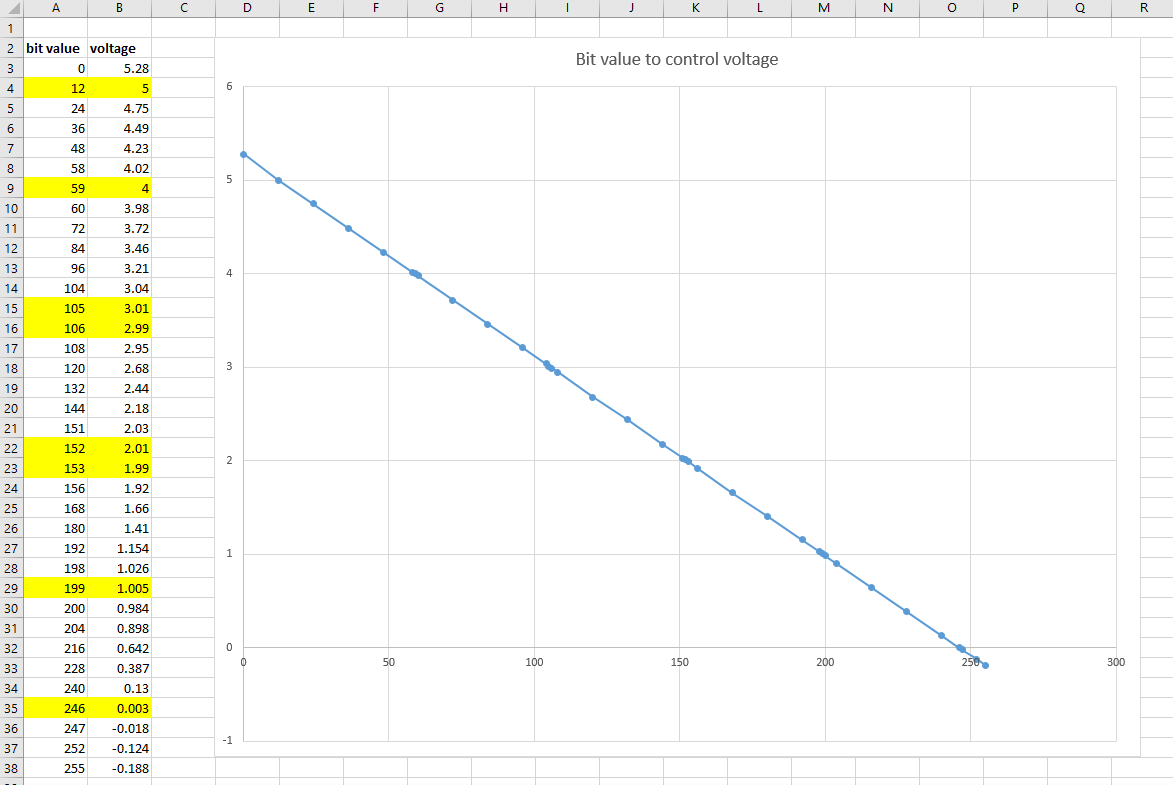
Testing the analog output resolution of the Euroduino: Note: Audio samples are not included yet, and there are more tests to be done on the sample rate section.
The previous articles in this series are:
Using the Arduino for electronic music #1, which introduces the subject. What signals are found in modular synthesizers?, which contains background information on the signals found in a modular synthesizer (Eurorack system modulars). The digital representation of modular synthesizer signals, which talks about what sampling rate and bit depth is needed to correctly represent these signals without artifacts and distortion. Using the Arduino for electronic music #2, which takes that background information and applies it to what the Arduino can be expected to read and write, with a focus on the Euroduino Eurorack module from Circuit Abbey. So far, we have dealt with the subject in the abstract, using best case scenarios and working from specification sheets. Reality is, as always much more messy. To start with, lets look at the most problematic part of the platform, the analog outputs of the Arduino in it’s default state using the Euroduino module as a testing ground.
...